INTARSIA WOOD ART
Artistic wood creations, handcrafted and proudly made in Canada.


Paul McCartney — Höfner 500/1 Violin Bass
The unmistakable violin-shaped bass that became inseparable from Paul McCartney and helped define the sound and image of The Beatles.
Quick Facts
Artist:
Paul McCartney
Built::
1963
Model:
Hofner 500/1 Violin Bass
Most Famous songs:
• Love Me Do
• I Want to Hold Your Hand
• All My Loving
• Paperback Writer
• Get Back
The Story
Paul McCartney first encountered the Höfner 500/1 while playing in Hamburg in 1961. Its symmetrical violin-shaped body made it particularly practical for a left-handed player, and its relatively affordable price made it an attractive alternative to the more expensive basses available at the time.
In 1963, McCartney purchased the Höfner that would become his famous “#1” bass. Its lightweight hollow body and warm tone became an important part of the early Beatles sound, while its unusual violin shape quickly became part of McCartney's visual identity.
As The Beatles' music evolved, McCartney's approach to the bass evolved with it. He increasingly treated the bass as a melodic instrument rather than simply providing the foundation for the rhythm section. His inventive bass lines became an essential part of the band's arrangements.
Although McCartney later became closely associated with the Rickenbacker 4001S, he continued to use his Höfner throughout his career. It returned to prominence during The Beatles' final recording sessions and, most famously, during the band's legendary rooftop performance at Apple Corps in January 1969.
For millions of fans, the image of McCartney with his Höfner has become one of the defining visual symbols of The Beatles.
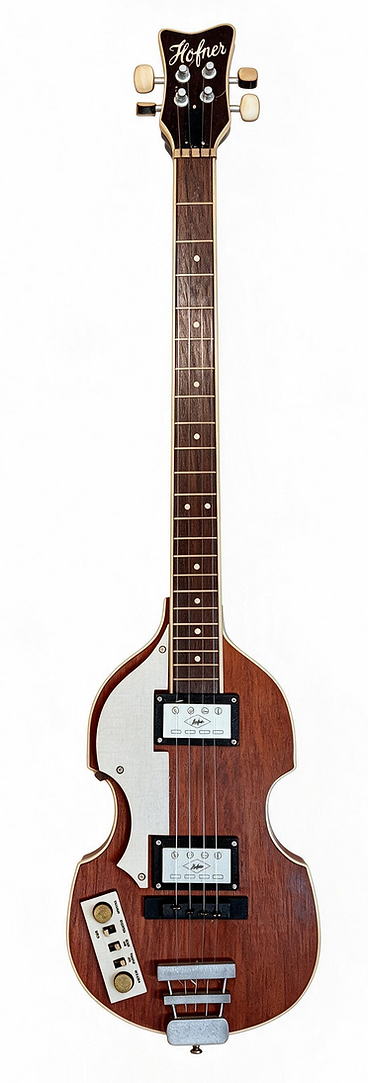

Why This Guitar Matters
The Höfner 500/1 is one of the rare instruments where the musician and the instrument became inseparable.
McCartney transformed the role of the bass in popular music. His playing could be melodic, rhythmic, aggressive or surprisingly subtle, often providing a second melody underneath the vocals.
The Höfner's distinctive tone became an important part of the early Beatles recordings, while its unusual shape made it instantly recognizable on stage.
It wasn't simply the bass Paul McCartney played.
It became part of the Beatles' identity.
The Craft Behind the Tribute
Every Guitar Legends shadow box begins with careful research. Before selecting a single piece of wood, I study the instrument, its history, the musician who played it, and the performances that made it unforgettable.
For McCartney's Höfner, the distinctive violin-shaped body presented an interesting challenge. The compact proportions, symmetrical body, two pickups and unusual control layout all had to be reproduced while retaining the warmth and character of the original instrument.
The surrounding artwork helps place the bass within its history. Engraved images of McCartney and The Beatles accompany a period-inspired Fender Bassman advertisement, reflecting the equipment and era surrounding the band's final performances.
Each component is individually handcrafted, assembled and finished to create a one-of-a-kind tribute celebrating both musical history and one of the most recognizable bass guitars ever made.
Design Philosophy
The Höfner's greatest strength is its simplicity. Its violin-inspired body, natural wood finish and compact proportions give it a warmth that contrasts sharply with many of the more aggressive-looking electric basses that followed.
My goal was to preserve that warmth while allowing the natural character of the wood to become part of the finished artwork. The result is a tribute that feels unmistakably vintage and unmistakably McCartney.

Design Choices
Songs That Define Beatlemania
-
Love Me Do - One of The Beatles' earliest recordings, representing the beginning of the band's extraordinary journey and McCartney's development as a bass player.
-
I Want to Hold Your Hand - The song that helped launch Beatlemania in America, combining McCartney's driving bass with one of the band's most infectious arrangements.
-
All My Loving - A great example of McCartney's melodic approach to the bass. His moving bass line contributes significantly to the song's musical identity.
-
Paperback Writer - McCartney's unusually prominent bass playing became one of the recording's defining features and demonstrated just how important the bass had become in Beatles arrangements.
-
Get Back - The perfect song to close the story. McCartney's Höfner was front and centre during the Beatles' final public performance on the roof of Apple Corps.
Specifications
-
25" by 11"
-
Baltic birch backing
-
Poplar frame
-
Solid hardwood guitar
-
Laser engraved artwork
-
Hand assembled
-
Ready to hang
Every Guitar Legends piece reflects the personality of the instrument and its player.
For the Höfner, the bass remains the focal point, with the surrounding elements providing historical context rather than competing for attention.
The engraved photographs connect McCartney to the instrument, while the Beatles imagery and Fender Bassman artwork place it firmly within the late-1960s Beatles story.
Hofner Through the Years
-
1961 – McCartney purchases his first Höfner 500/1 while performing in Hamburg.
-
1963 – He purchases the Höfner that becomes his principal “#1” bass during the Beatles' most successful years.
-
1964–1966 – The Höfner becomes one of the most recognizable instruments of the Beatlemania era.
-
1965 onward – McCartney increasingly uses a Rickenbacker 4001S for recording, but continues to use the Höfner for performances and selected recordings.
-
1968–1969 – The Höfner returns to prominence during the Let It Be sessions.
-
January 30, 1969 – McCartney plays the Höfner during The Beatles' legendary rooftop performance at Apple Corps in London—the band's final public concert.
-
Later years – McCartney eventually returns to the Höfner as a major part of his live setup, and the instrument remains closely associated with his musical identity.

Look closely at McCartney's bass during the famous rooftop performance and you'll see a little “BASSMAN” sticker.
The sticker came from the Fender Bassman equipment being used by The Beatles during the Let It Be sessions. McCartney placed it on his Höfner, and it was still there when The Beatles performed together on the roof of Apple Corps on January 30, 1969.
That tiny sticker could easily be missed in the concert footage. I didn't miss it.
I deliberately recreated it in this shadow box because it's one of those wonderfully obscure details that connects the instrument directly to one of the most famous moments in Beatles history.
Note From The Artisan
I don't build replicas—I build stories. Every wood species, engraving, photograph, and historical detail is chosen to preserve the legacy of an instrument that helped shape modern music.
The Höfner 500/1 is one of those rare instruments where the shape, sound and musician have become impossible to separate. For an entire generation, seeing that little violin-shaped bass meant one thing:
Paul McCartney. The Beatles.
My hope is that this tribute captures not only the instrument, but a moment in music history when four musicians changed popular music forever—and left behind one very recognizable little bass as part of the story.